
 Custom Printed Coffee Bag with Valve
Side Gusset Bags
Side gusset bags have two folded side panels that open as the bag fills, and it is the shape the coffee trade has used longest. Standard fills run from 250 g to 2 kg in kraft, foil and compostable laminates, with a one-way degassing valve on most and a tin tie or zipper where the pack is opened daily. The format is efficient on film and gives a narrower facing at lower cost than a flat bottom bag, which is why roasters running several origins tend to standardise on it.
In this range26 products
Minimum orderFrom 1,000 pieces
SamplesStock samples free
Lead time15-25 days after approval
-
Custom Printed Coffee Bag with Valve
-
 Custom Printed Coffee Bag with Zipper and Valve
 -
 Custom Printed Coffee Bag with Zipper and Valve and Window (2 kg)
 -
 Custom Printed Coffee Bag with Zipper and Valve No. 4
 -
 Custom Printed Compostable Coffee Bag with Valve
 -
 Custom Printed Compostable Coffee Bag with Zipper and Valve No. 3
 -
 Custom Printed Compostable Side Gusset Bag for Coffee (1 kg)
 -
 Custom Printed Compostable Side Gusset Bag for Coffee (1 kg) No. 2
 -
 Custom Printed Compostable Side Gusset Bag for Coffee (1 kg) No. 3
 -
 Custom Printed Compostable Side Gusset Bag with Zipper (1 kg)
 -
Custom Printed Foil Coffee Bag with Valve (250 g)
-
 Custom Printed Foil Coffee Bag with Zipper and Valve No. 2
 -
 Custom Printed Foil Matt Coffee Bag with Zipper and Valve
 -
Custom Printed Foil Matt Coffee Bag with Zipper and Valve No. 2
-
 Custom Printed Foil Matt Side Gusset Bag with Zipper and Valve (250 g)
 -
 Custom Printed Foil Side Gusset Bag for Coffee (500 g)
 -
 Custom Printed Kraft Side Gusset Bag for Coffee (1 kg)
 -
 Custom Printed Kraft Side Gusset Bag for Coffee (1 kg) No. 2
 -
 Custom Printed Kraft Side Gusset Bag for Coffee (250 g)
 -
 Custom Printed Matt Coffee Bag with Valve (250 g)
 -
 Custom Printed Paper Pouch for Dried Fruit No. 2
 -
 Custom Printed Recycled Kraft Side Gusset Bag for Coffee
 -
 Custom Printed Recycled Side Gusset Bag for Coffee (1 kg)
 -
 Custom Printed Side Gusset Bag for Coffee
 -
 Custom Printed Side Gusset Bag for Coffee (1 kg)
 -
 Custom Printed Whey Protein Bag with Zipper (1 kg)
How a side gusset bag is built
Two Folded Sides That Open as the Bag Fills
A side gusset bag has a folded panel down each side that opens as the bag fills, giving a tall pack with a small footprint. Per litre of contents it uses less film than any self-standing construction, which is why 250 g and 1 kg wholesale coffee, rice and grain have used it for decades.
Gusset Depth, Again
Too shallow and the bag will not take the volume; too deep and it goes fat and short and loses the tall silhouette that made you choose it. We work it back from fill weight and bulk density, then confirm it on a sample before any cylinder is engraved.
Vacuum and One-Way Valves
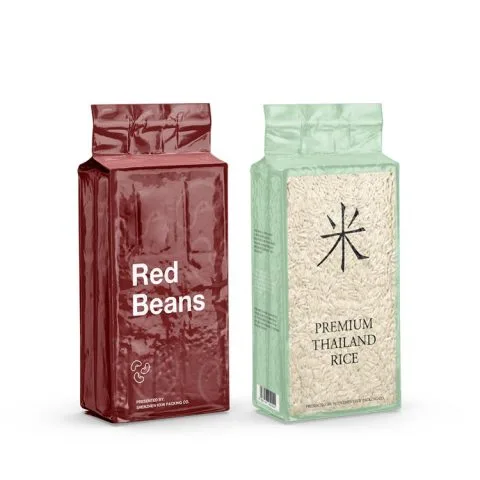
This construction takes a vacuum well: drawn down, the gussets pull flat into a brick, which is how whole bean coffee and rice ship. Where the contents off-gas, a degassing valve goes in the front panel — on a vacuum pack that valve is what stops the brick inflating on the shelf.
Against the Alternatives
| Construction | Film per litre | Shelf presence |
|---|---|---|
| Side gusset | Lowest | Tall and narrow; front panel only |
| Flat bottom | Highest | Five printed panels; stands square |
| Stand up | Middle | Wide front; leans as it empties |
Narrow it down
Where Side Gusset Bags Sits in the Range
The numbers are how many packs in this range are also in that one, counted from the catalogue rather than chosen by hand.
The Materials It Runs In
What This Range Is Used For
Frequently asked
Specifying Side Gusset Bags: The Questions That Decide It
What is a side gusset?
A panel folded into each side of the bag that opens as it fills. It lets a tall narrow pack hold a large volume on a small footprint using very little film.
How deep should the gussets be?
Set from your fill weight and bulk density. Too shallow and the bag will not take the volume; too deep and it goes fat and short and loses the tall silhouette.
Why is it the traditional coffee bag?
Because it carries the most volume per metre of film of any self-standing construction, and 1 kg wholesale coffee is bought on cost per kilo, not on shelf presence.
Can it be vacuum sealed?
Yes, and it is the construction that takes a vacuum best: drawn down, the gussets pull flat into a brick. That is how whole bean coffee and rice ship.
Do I still need a degassing valve on a vacuum pack?
For coffee, yes. The valve is what stops the brick inflating on the shelf as the roast continues to off-gas.
How does the top close?
Tin tie, zipper, or a folded pinch top depending on the market. Tin tie reads as speciality; a zipper is the airtight reclosure.
How much printable area is there?
One narrow front panel, plus the gussets when the bag is full. If the design needs room, a flat bottom bag gives five printable faces instead.
Will it stand up empty?
Barely. It is designed to stand filled; an empty or half-empty bag leans. On a shelf that has to face for weeks, flat bottom is the safer construction.
Can it have a hang hole?
Yes, in the top seal with reinforcement. Tell us early because the hole needs seal land around it.
What sizes are standard?
250 g, 500 g, 1 kg, 2 kg and 5 kg cover most of what we run, and anything between is made to your drawing.