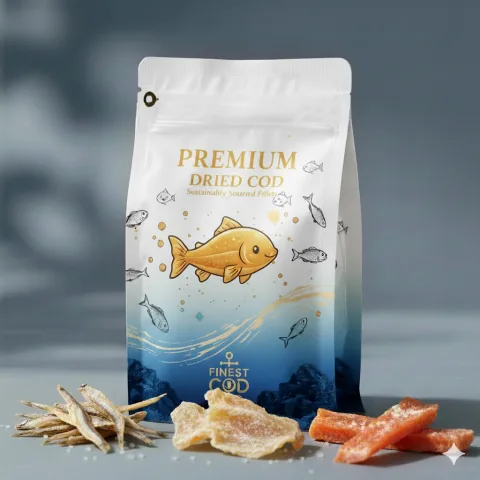
PET on the outside carries the print, PE on the inside carries the seal. The barrier is set against your stated shelf life rather than to a house default, so the film gets heavier only where the product needs it to. An odour barrier works in both directions: nothing escapes the pack, and nothing from the shelf beside it gets in. Because the barrier is tuned rather than maximised, there is usually room for recycled content or a recyclable mono-material build without losing the shelf life.
A pack of dry pet food, treats and chews is opened and shut many times before it is finished, so the zipper is specified for repeated cycles rather than for the first one. Film gauge and seal width are stepped up for the fill weight, so the bag survives palletising and the last mile.
About this pack
What It Is for, and What It Has to Survive
Where This Pack Is Used
Dry pet food and treats, which fail in three predictable ways: a split seal under a dropped bag, fat from the kibble migrating into the film and greying the print, and a pack that will not stand once a third has been scooped out.
How It Is Built
Five sealed panels with a real base rather than a fold, so the pack stands square and keeps its footprint as it empties. The two side gussets carry the small print, which leaves the front and back clear for the brand.
A PET/PE laminate: polyester outside for the print and the handling, polyethylene inside for the seal. It is the structure most retail packs are built on, and for most retail products it is the correct answer rather than the cheap one.
Specified with post-consumer recycled film in the outer layers and a virgin sealant against the contents, because food-contact rules do not allow recycled material to touch the fill. The percentage is stated in the specification rather than left as a claim.
Made on One Site
Every pouch on this site is produced in our own plant in Shenzhen, China. Film is extruded or sourced to the structure your product needs, printed by gravure from your artwork, laminated, cured, then converted on bag-making lines set up for your format and fill weight. Because those steps sit under one roof, a colour that drifts or a seal that fails a drop test is corrected on the line the same day.
Customising This Pouch
- Size and fill. Standard fills from 100 g to 2 kg, or built to your drawing. Tell us the product and the fill weight and we will come back with a gusset depth and film gauge.
- Barrier. Foil, metallised, transparent high-barrier or compostable, chosen against your shelf life and the market it ships to — not against a house default.
- Closure. Zipper, child-resistant zipper, tear notch, degassing valve, tin tie, hang hole or spout. Specified at the die stage.
- Print. Gravure from vector artwork, CMYK or Pantone, up to ten colours, matt or gloss. Spot UV and soft-touch finishes available.
- Windows. Die-cut to your artwork rather than dropped into a stock position.
Ordering
Send us the product, the fill weight, the format and the quantity per SKU. We reply with a real quote rather than a range. Artwork goes as vector — AI, EPS, PDF or SVG with fonts outlined — and if you have no designer, our graphics team builds the dieline and lays it out for you. You approve a digital proof before any cylinder is engraved, and for colour-critical work we run a press proof on the real substrate first. See the full ordering process.
Certification and Audits
Compostable lines are certified rather than claimed: OK compost HOME and INDUSTRIAL, BPI, DIN CERTCO and AS 5810 against EN 13432, with FDA and LFGB for food contact. The plant is audited to BRCGS, Sedex, BSCI, ISO 9001 and ISO 14001. More about our plant.